
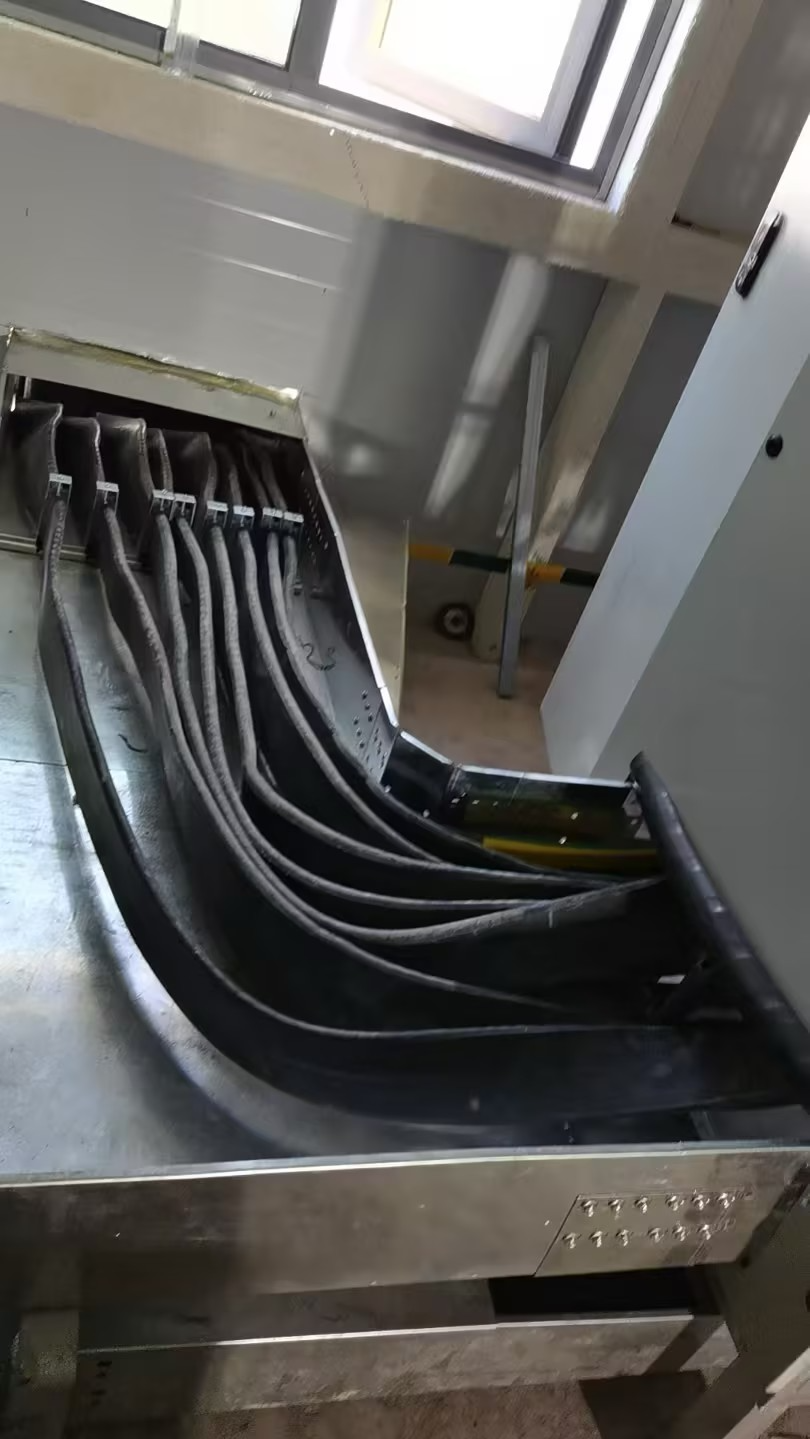
This project involved the power distribution interconnection between a box-type substation and low-voltage cabinets at a chemical factory in Dengfeng, Henan. The original design employed a 240 mm² multi-split cable scheme that suffered from significant current derating due to parallel operation, high material costs from excess cable quantities, excessive joint counts, and complex laying paths that hindered construction efficiency and introduced long-term operational risk. After a comprehensive technical and economic evaluation, Yanghua's ZC-TMRYY flexible busbar was selected as the optimal alternative. The busbar's compact structure and small bending radius enabled a dramatic reduction in joints, simplified routing, and improved construction speed. While the per-meter material cost was marginally higher, the overall project cost decreased substantially through savings on cable terminals, labor, and installation time.
Project Background & Challenges
The original 240 mm² multi-split cable solution between the box-type substation and low-voltage cabinets suffered from current-carrying derating due to parallel cable operation, leading to inflated material costs. The high number of splices, complex laying paths, and labor-intensive installation created significant construction inefficiencies and long-term reliability concerns.
- Current-carrying derating in parallel multi-split cables causing reduced effective capacity and increased material requirements
- Excessive joint count creating multiple potential failure points and increasing installation labor
- Complex cable laying paths consuming excessive construction time and complicating routing in confined spaces
- High total project cost driven by cable terminal quantities, labor intensity, and extended installation schedule
Solution
Yanghua replaced the multi-split cable scheme with ZC-TMRYY flexible busbar, which features a compact structure and small bending radius. This dramatically reduced joint counts, simplified laying paths, and lowered overall project cost despite marginally higher per-meter material pricing.
- Selected ZC-TMRYY flexible busbar with compact profile and tight bending radius to replace multi-split cables
- Drastically reduced splice joints by using continuous busbar runs, lowering resistance and failure risk
- Simplified laying path design enabled faster, more efficient construction with fewer installation personnel
- Achieved net cost reduction by eliminating large quantities of cable terminals and reducing total labor hours
Project Results
Products Used
Project Gallery
Related Projects
Explore similar industrial busbar installation cases
Steel Mill Modernization
High current busbar solution for steel production modernization with flexible copper busbar systems

Large Steel Enterprise Power Distribution Project, Fujian
A 3200A flexible busbar solution for a major steel producer, connecting transformers to low-voltage cabinets using copper bar direct overlap connections without additional joints, with onsite cut-to-length capability for flexible installation in narrow bridges and cabinets.

Baotou Aluminum Industrial Park — IP68 Flexible Busbar Power Distribution Room Retrofit
Retrofit of transformer-to-low-voltage cabinet connections in an aluminum industrial park, replacing hot-spot-prone conventional busbars with point-to-point IP68 flexible busbars for enhanced safety.
Inquire About Similar Projects
Get Quote for Similar Project
Connect this project to the next decision
Review the related product range, application solution, technical hub, and engineering quotation path for a comparable installation.