Cost Comparison: Flexible Busbar vs Multiple Parallel Cables TCO Analysis
Direct answer: For high-current industrial and renewable energy applications, flexible busbar typically offers lower total cost of ownership (TCO) compared to multiple parallel cables, due to reduced copper volume, simpler installation, and lower energy losses. However, flexible busbar is not suited for all scenarios — it is preferable for confined spaces, high-density routing, and systems with vibration or frequent movement. Parallel cables remain more cost-effective for very short runs, low-current applications, or where existing cable infrastructure is already installed. The decision depends on current rating, installation distance, and space constraints.
Application Scenario
Flexible busbar is applied in switchgear, power distribution panels, wind turbines, and energy storage systems where multiple high-current circuits must be routed through tight spaces. It replaces several parallel single-core cables with a single, flat, laminated conductor that can bend to fit around obstacles. [K1]
The typical application drivers include:
- Space-constrained compartments: flexible busbar reduces the overall cross-sectional area of conductor required.
- Systems with vibration or thermal cycling: flexible busbar’s construction withstands movement without loosening termination points.
- High current density: above 125A per phase, the TCO advantage of flexible busbar increases.
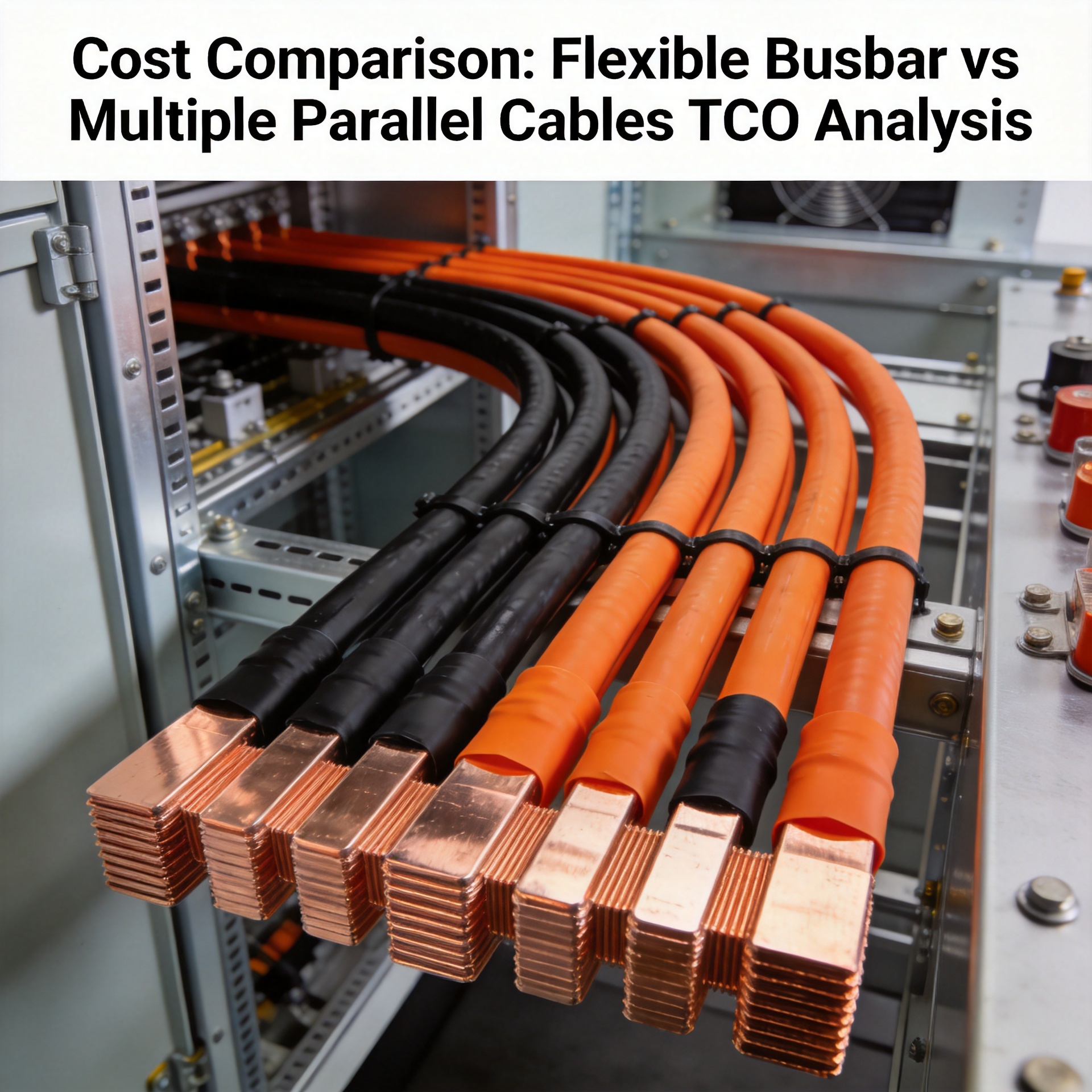
Engineering decision criteria:
| Criterion | Flexible Busbar | Multiple Parallel Cables |
|---|---|---|
| Copper mass | 20–40% less copper for same ampacity [K2] | Higher copper mass per circuit |
| Installation labor | Shorter install time, simpler routing [K2] | Longer pulling, termination, and cable management |
| Radiated heat dissipation | Flat profile dissipates heat efficiently | Round cables trap heat in bundles |
| Bend radius tolerance | Tight bends possible (up to 90°) | Large bend radius required at terminations |
| System weight | Lighter overall | Heavier due to insulation mass |
| Short-run cost (<5m) | Moderate setup cost for custom lengths | Lower per-unit cable cost |
Engineering Decision Criteria
The TCO breakpoint depends on:
- Current rating per phase: Flexible busbar becomes cost-competitive above 125A. Below this, standard cables may be cheaper.
- Routing distance: For runs under 3 meters, parallel cables can be lower cost. For 3–15 meter runs, flexible busbar shows TCO savings of 10–25% [K2].
- Number of bends: Each cable bend requires more pull length and increases termination effort. Flexible busbar handles multiple bends in one continuous piece.
- Future maintenance: Flexible busbar terminations are easier to access and re-terminate than multiple cable lugs in tight junction boxes.
Suitable Cases
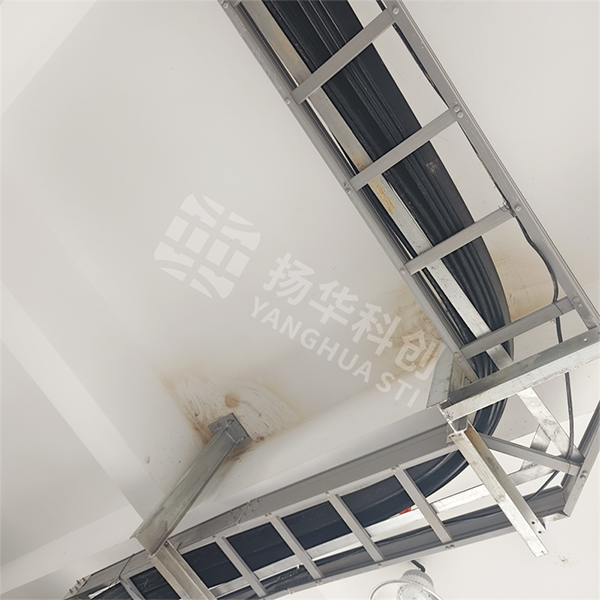
Flexible busbar is recommended for:
- Energy storage battery racks: where space between battery modules is minimal and high ampacity connections are needed.
- Wind turbine nacelles: where vibration, temperature extremes, and limited access make cable routing difficult.
- UPS and switchgear: where multiple outgoing circuits share a common panel and require neat, compact routing.
Not Suitable Cases
Parallel cables remain the better choice when:
- Existing cable trays and infrastructure are already in place — retrofitting flexible busbar may introduce unnecessary cost.
- Distance is very short (under 1 meter) and ampacity is low (<100A) — standard cable performs adequately.
- System requires frequent reconfiguration with standard off-the-shelf cables — custom busbar lengths add lead time.
- Bidding specifications explicitly require single-core cables per code — flexible busbar may require special approval.
Procurement Notes
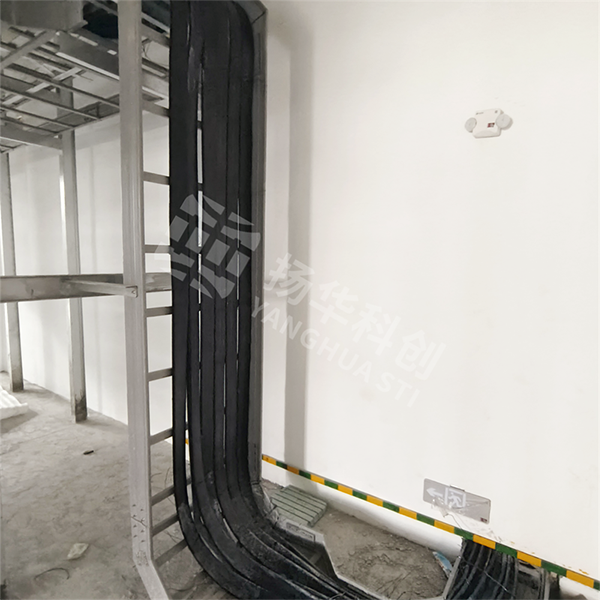
- Provide the exact current rating, ambient temperature, bend positions, and termination detail to the busbar supplier for custom fabrication [K2].
- Specify the number of phase layers (typically 1 to 4) and whether a ground/neutral bar is needed.
- Request a copper mass comparison from your supplier to validate material savings against your current cable bill-of-materials.
- Verify that all terminations comply with local electrical codes — some jurisdictions have specific requirements for laminated busbars.
Frequently Asked Questions
Q1: Will flexible busbar reduce my total copper cost compared to multiple parallel cables? Yes, typically by 20–40% because flexible busbar uses laminated flat conductors with thinner insulation, reducing the copper mass required for the same current-carrying capacity. [K2]
Q2: How long does it take to install flexible busbar versus pulling multiple parallel cables? Installation time is generally shorter for flexible busbar because it arrives as a single, pre-assembled conductor that is simply bolted into place. Most installations require 30–50% less labor time compared to pulling, supporting, and terminating multiple individual cables. [K2]
Q3: Can flexible busbar be used in outdoor or high-temperature environments? Yes, but the specific temperature rating depends on the insulation material. Most flexible busbars are rated for –40°C to +105°C ambient. Verify the continuous operating temperature against your site conditions before ordering.
Q4: How do I calculate the TCO for my specific project? Request a TCO calculator from your busbar supplier. The calculation should include copper mass, insulation volume, installation labor, energy losses (I²R), and reduced cable tray/raceway costs.
Q5: Is there a risk of overheating when using flexible busbar in a confined space? Flexible busbar generally runs cooler than bundled cables because its flat profile dissipates heat more effectively. However, always check the manufacturer’s ampacity de-rating table for stack configuration and enclosure type.
About the Author Yanghua Editorial Team — This article is maintained in the Astro MDX repository and reviewed against the source materials listed for the page.
Certifications, test reports, and performance claims require explicit approval before public publication.
Contact: info@yhflexiblebusbar.com | Phone: +86-769-3893-9888