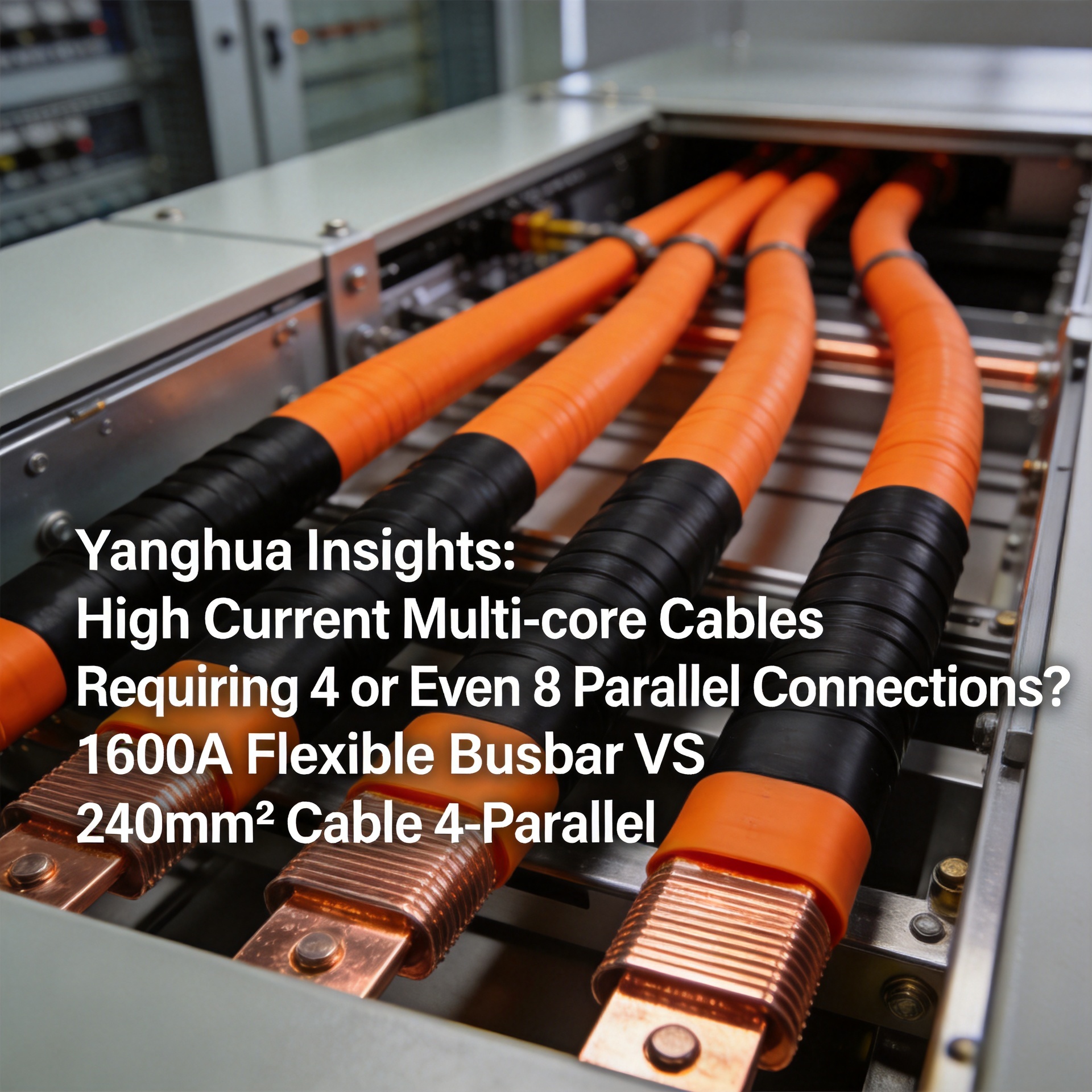
Yanghua Insights: High Current Multi-core Cables Requiring 4 or Even 8 Parallel Connections? 1600A Flexible Busbar VS 240mm² Cable 4-Parallel
Direct answer: For high-current applications requiring 1600A or more, using 4-parallel 240mm² cables is practical but introduces significant installation complexity, space constraints, and current imbalance risks. Yanghua’s 1600A flexible busbar offers a simpler, space-saving alternative that reduces parallel connections from 4 (or even 8) to a single, compact assembly, improving reliability and thermal performance without derating [K1].
Application Scenario
High-current multi-core cables are commonly specified in large industrial plants, data centers, renewable energy storage systems, and power distribution units (PDUs) where loads exceed 1000A. When a single cable cannot handle the ampacity, engineers often resort to multiple cables in parallel—4, 6, or even 8 runs—to meet the total current requirement [K1]. However, this approach introduces mechanical and electrical challenges, especially in confined spaces or high-ambient-temperature environments.
Engineering Decision Criteria
When choosing between 4-parallel 240mm² cables and a 1600A flexible busbar, consider the following factors:
| Criteria | 4×240mm² Cable | 1600A Flexible Busbar |
|---|---|---|
| Ampacity | ~1600A (depends on cable de-rating, bundling, and ambient temperature) | 1600A rated, no derating for parallel imbalance [K1] |
| Installation space | Large bend radius; requires multiple cable trays and significant floor/wall space | Compact; single assembly with 90° or flat routing possible |
| Parallel connections | 4 cables + 4 terminations per phase; risk of uneven current sharing | Single conductor per phase; no current imbalance [K1] |
| Fire safety | PVC or LSZH sheathed, but multiple runs increase fire load | Metallic or specialized sheath options; reduced combustibility |
| Thermal management | Higher heat density due to multiple cables bundled together; needs derating | Lower heat density; better heat dissipation through open busbar design |
| Maintenance | Difficult to isolate one cable for testing or replacement; work on live cables dangerous | Single conductor, easier visual inspection and maintenance |
| Cost | Lower upfront material cost; higher labor and installation cost | Higher upfront; lower total installed cost in complex runs [K1] |
Suitable Cases
- Data center power feeds: Where space under floor or overhead is limited, and neat routing is essential for airflow and access.
- Renewable energy inverters: High current from multiple MPPT inputs can be consolidated into one busbar, simplifying wiring.
- Large motor connections: For motors above 1000A, 4-parallel cables become unwieldy; busbar offers reliable, balanced current sharing [K1].
- Retrofits in existing trays: When adding new circuits but cable trays are full, busbar can be installed on wall or rack without new tray runs.
Not Suitable Cases
- Short, point-to-point distances (<5 meters): The cost of a busbar system may not be justified if simple cable runs meet ampacity with minimal derating.
- Fixed, low-ambient-temperature environments: If space and heat are not concerns, 4-parallel cables remain a standard, low-cost option.
- Projects with strict fire resistance requirements (e.g., >90 minutes): While busbar options exist, standard flexible busbar may not meet all fire ratings; cables with specialized fireproofing could be preferred [Caveat: verify with local codes].
- Existing inventory compatible situations: If the facility already stocks 240mm² cable and terminations, using additional parallel cables may be more practical from procurement standpoint.
Procurement Notes
- Verify ampacity with derating factors: 4-parallel 240mm² cables must be de-rated for bundle correction, ambient temperature, and altitude. Expect typical derating of 15-30%, meaning actual capacity may be closer to 1200-1400A, not 1600A [K1].
- Request thermal rise test data: Ask the supplier for temperature rise test reports at 1600A to confirm busbar or cable assembly performs within limits.
- Specify termination kit: For busbar systems, ensure the supplier provides pre-formed bends, splice kits, and support brackets compatible with your cabinet or tray dimensions.
- Plan for future upgrade: Busbars allow easy addition of tap-offs or higher amperage by swapping conductor layers; cables would require entirely new runs.
- Inquire about corrosion protection: For outdoor or wet applications, confirm whether the busbar has anodized or plated coatings [K1].
Frequently Asked Questions
Q: Can I use 8 parallel cables to get 3200A instead of one busbar?
A: Yes, but each additional cable increases current imbalance risk and installation complexity. At 8-parallel, even small differences in impedance cause uneven load sharing, potentially leading to hot spots and premature failure [K1]. A single 3200A busbar is more reliable and often less expensive in total installed cost.
Q: What if my distance is very long, say 100 meters?
A: For long runs, voltage drop becomes a major factor. 4-parallel 240mm² cables at 100m will have higher impedance than a properly sized busbar. Consult the supplier for voltage drop calculations. In long distances, the busbar’s lower inductance and resistance may offer better performance [K1].
Q: Do 4-parallel cables require current sharing devices?
A: Sometimes. To ensure balanced current sharing, engineers may install current monitoring CTs and even resettable fuses per cable. Without these, it’s common for one cable to carry 30-40% over its rating while others carry less [K1]. A busbar eliminates this need.
Q: Is the flexible busbar rated for outdoor or wet environments?
A: Standard flexible busbar is typically indoor/covered application. For outdoor use, specify a weatherproof enclosure or purchase IP65-rated busbar assemblies. Cables are naturally weather-resistant if selected with UV-stable jacket materials [K1].
Q: What is the typical lead time for a 1600A flexible busbar system vs. ordering cables?
A: Cables are often off-the-shelf, while busbar systems may require 2-4 weeks for fabrication, depending on customizations like pre-drilled holes, bends, or termination kits. Plan accordingly based on project schedule [K1].
About the Author Yanghua Editorial Team — This article is maintained in the Astro MDX repository and reviewed against the source materials listed for the page.
Certifications, test reports, and performance claims require explicit approval before public publication.
Contact: info@yhflexiblebusbar.com | Phone: +86-769-3893-9888